

The best heat setting for cramps sits between 100°F and 107°F (38°C to 42°C) against the skin. Start on the lowest setting your device offers, or a low-heat adhesive patch, and give it 15 to 30 minutes before deciding whether you need more. A wearable device with adjustable heat and massage, like NuFemme, makes it easy to stay in that comfort zone all day without babysitting a cord.
TL;DR:
- Adhesive heat patches typically operate at around 100°F and are designed for 8 to 12 hours of use, keeping treatment simple during daily activities.
- Wearable heat belts like NuFemme are calibrated between 100°F and 107°F, providing continuous, adjustable relief suitable for all-day wear without oversight.
- Starting at the lowest heat setting and increasing gradually every 15 to 30 minutes reduces risk of burns and ensures effective pain relief tailored to individual sensitivity.
- Clinical evidence shows heat therapy can reduce menstrual pain by an average of 1.85 points on a 10-point scale, with some studies suggesting comparable effectiveness to NSAIDs.
- Safety rules include avoiding prolonged high-temperature use, never sleeping with a pad on, and inspecting skin regularly to prevent burns or other injuries.
Table of Contents
- Which Heat Setting Should You Use for Each Device?
- Why Does Heat Actually Relieve Cramps?
- What Are the Best Heating Pads for Pain, by Device Type?
- How Do You Find the Right Heat Setting for Your Body?
- What Safety Rules Should You Follow With Heat Therapy?
- What Does the Evidence Say About Wearable Heat Devices?
- How I Actually Use Heat Settings Day to Day
- NuFemme: A Wearable Built Around the Right Heat Range
- Sources
Which Heat Setting Should You Use for Each Device?
Not every heat source hits the same temperature, and that’s exactly why so many people either undertreat their cramps or accidentally scorch their skin. Matching the device to the right starting setting takes the guesswork out of it.
Here’s how the most common options break down:
- Adhesive heat patches: These single-use patches run low and steady, typically around 100°F (38°C), and are built for 8 to 12 hours of wear. Follow the package directions exactly. They’re not adjustable, so the manufacturer has already set them at a safe baseline.
- Electric heating pads: Most plug-in pads range from 104°F to 140°F (40°C to 60°C) at their highest settings, but for cramps you want the low or medium range, not the top. Use medium for 15 to 30 minutes, or low for longer stretches if you’re resting at home.
- Wearable heat belts: Rechargeable belts like NuFemme are designed to hold a steady 100°F to 107°F (38°C to 42°C), the exact window clinical guidance on superficial heat therapy recommends for women’s health applications. Because they’re built for continuous wear, they can run for hours without you needing to reheat or replace anything.
- Microwavable packs and hot water bottles: These deliver warmth, not a controlled dose. Warm them until comfortable, never scalding, and expect the heat to fade within 20 to 30 minutes.
Once you’ve picked a device, follow this simple protocol:
- Start low. Choose the lowest setting or a low-level patch, even if your cramps feel severe.
- Check in at 15 to 30 minutes. Notice whether the pain has eased and whether your skin looks normal.
- Increase only if needed. Move up one level at a time rather than jumping to high heat.
- Stop immediately if you notice burning or redness. That’s your skin telling you the setting is too aggressive for how long you’ve had it on.
Pro Tip: If you’re new to heat therapy, test any adjustable device on your forearm for a minute before applying it to your abdomen. Your lower belly and lower back can tolerate less heat than you’d expect.
Why Does Heat Actually Relieve Cramps?
Heat works because it changes what’s happening at the tissue level, not just how the pain feels. Warmth applied to the pelvis increases blood flow to the uterine muscle, which helps clear out prostaglandins, the hormone-like compounds responsible for the intense contractions behind menstrual cramps. More circulation means those compounds move on faster instead of building up and prolonging the spasm.
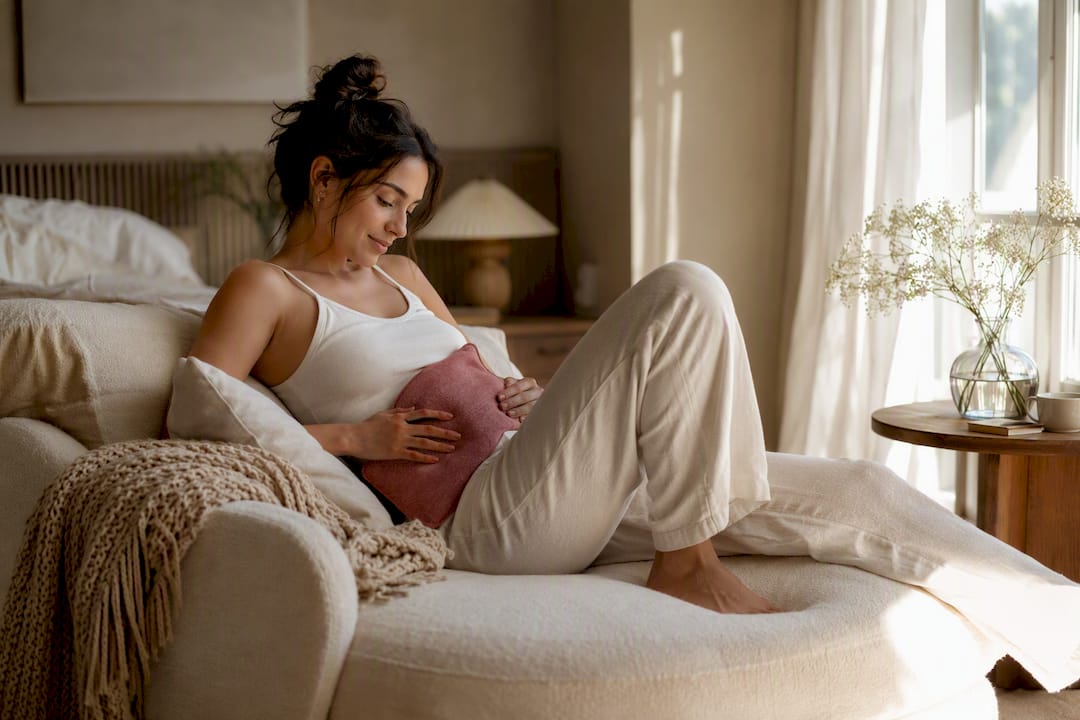
Heat also activates TRPV1 channels, heat-sensitive receptors in your skin and deeper tissue that essentially compete with pain signals for your nervous system’s attention. Your brain has a limited bandwidth for those signals, so the added heat sensation can turn down how intensely you register the ache underneath it. On top of that, warmth relaxes the smooth muscle of the uterus directly, which reduces the strength of the contractions causing the pain in the first place.
The clinical evidence behind this isn’t small. A systematic review and meta-analysis covering 57 randomized trials and 5,359 participants found that heat therapy reduced pain scores compared with no treatment at all, with some trials showing heat performed comparably to NSAIDs for short-term relief. Separate randomized trial data on heat wraps backs this up, showing clinically meaningful reductions in pain that sometimes matched over-the-counter pain relievers.
The certainty behind these findings ranges from low to moderate, since many trials are still on the smaller side. But the direction of the effect is consistent: heat works best for primary dysmenorrhea (cramps without an underlying condition like endometriosis) and for muscle cramp episodes generally, offering a moderate reduction in pain rather than a total cure.
Across the pooled trials, heat reduced pain scores by an average of 1.85 points on a 10-point visual analog scale compared with no treatment, a difference patients could feel within the same cycle they started using it.
What Are the Best Heating Pads for Pain, by Device Type?
Every heat source has a temperature ceiling, a wear time, and a tradeoff. Knowing what each one is actually built to do saves you from either underdosing your cramps or overheating your skin.
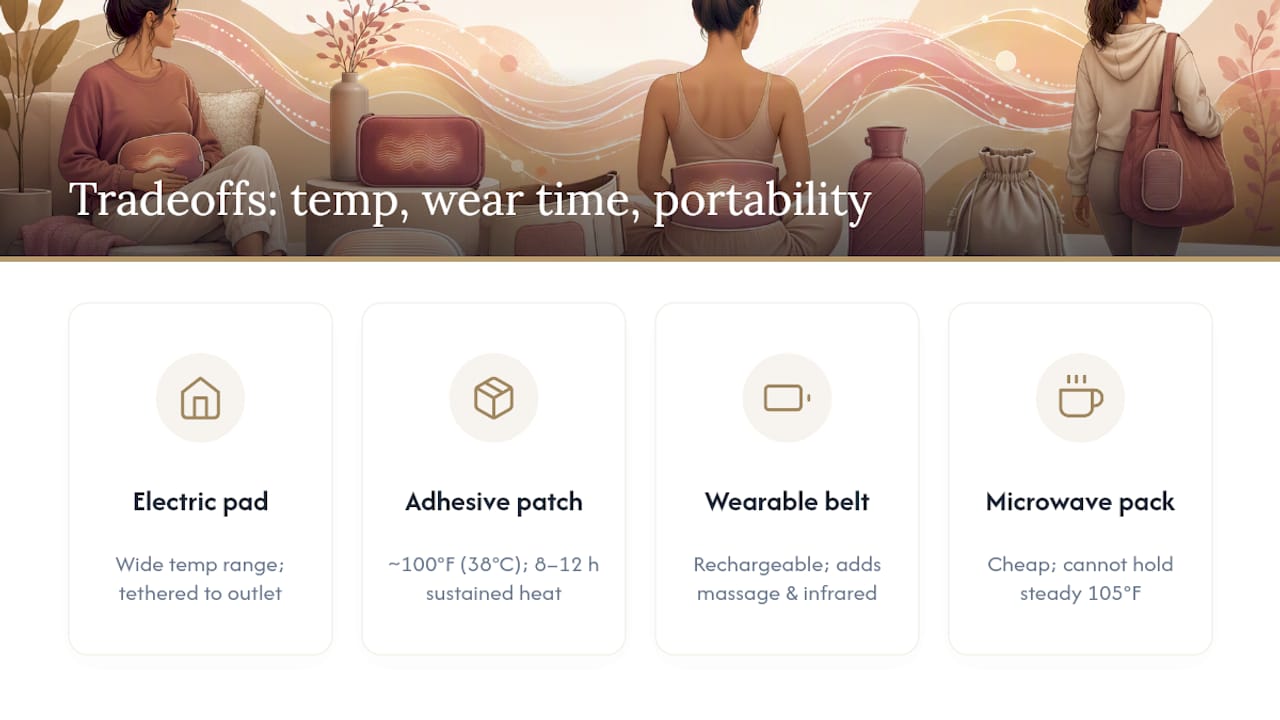
Electric corded heating pads are the classic option for a reason. Most offer a wide range, but for cramps you want to stay in the lower half of that dial. They’re best suited to home use, since you’re tethered to an outlet and can’t exactly run errands with one strapped to your waist. A standard electric heating pad works well for an evening on the couch but loses its appeal the moment you need to leave the house.
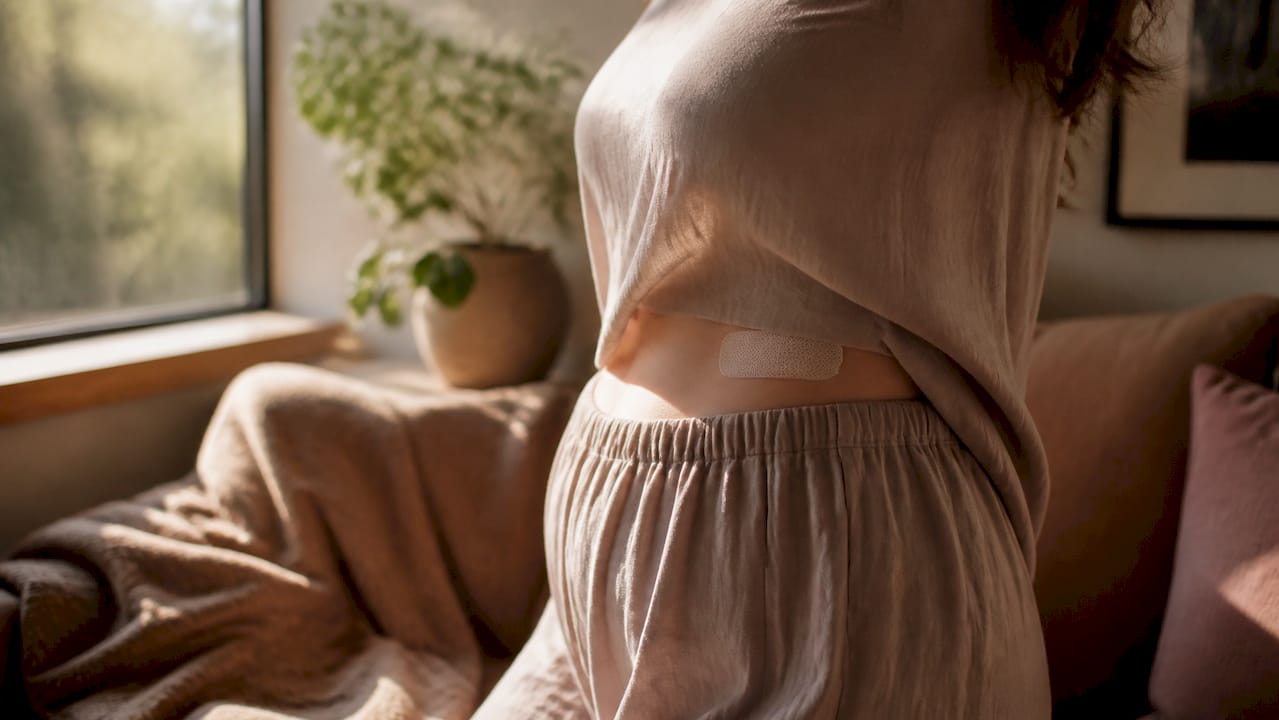
Adhesive heat patches solve the portability problem. They deliver sustained low heat, generally around 100°F (38°C), for 8 to 12 hours, which makes them ideal for a long commute or a full workday when mild cramps are more of a background nuisance than an emergency.
Wearable belts split the difference: rechargeable, motion-friendly, and often built with more than heat alone. Devices in this category commonly stack in massage and infrared (red-light) therapy, giving you a multimodal approach that keeps you within the recommended low-heat range while adding a second and third layer of comfort. Battery life and full-abdomen coverage tend to be the deciding factors here.
Microwavable packs and hot water bottles are cheap and always available, but temperature control is really a guess. You reheat until it feels right, and there’s no way to hold a steady 105°F for two hours.
Infrared heat penetrates more deeply than surface heat, reaching muscle tissue rather than just skin. That matters more for chronic muscle tightness than for menstrual cramps, where superficial heat over the uterus is usually sufficient.
How Do You Find the Right Heat Setting for Your Body?
Cramps vary wildly from person to person, so the setting that works for your roommate might do nothing for you, or might be too much. A short, repeatable process beats guessing every month.
- Begin on the lowest setting your device allows and wait 10 to 15 minutes before touching the dial.
- Move up in small increments, one level at a time, checking your skin each time for redness or unusual sensitivity.
- Match the setting to your pain level. Mild cramps usually respond to low heat; moderate cramps may need medium. Reserve higher settings for devices with real safety controls, and only if a clinician has cleared it for your situation.
- Reassess for special circumstances. Pregnancy, postpartum recovery, neuropathy, recent abdominal surgery, or breastfeeding all change how your body handles heat exposure. ACOG’s guidance on dysmenorrhea lists local heat as a reasonable self-care option, but talk to your provider first if any of these apply to you.
When you’re shopping for a device, run through this checklist:
- Does it offer granular heat control, not just one fixed setting?
- Does it have a timer or auto-shutoff feature?
- Is the cover washable?
- How long does the battery last on a full charge, if it’s cordless?
- Will it stay discreet under your clothes for a full workday?
What Safety Rules Should You Follow With Heat Therapy?
Heat is one of the safest pain relief tools available, but “safe” still comes with rules worth following every time.
- Respect session limits. Higher-temperature pads should stay on for 15 to 30 minutes at a time. Low-level wearables designed for continuous wear can often run 8 to 12 hours, but check your specific device’s rating.
- Always use a barrier. A thin layer of fabric between skin and heat source reduces burn risk significantly, and you should check your skin periodically for redness.
- Never sleep with a high-temperature pad on. If you tend to doze off, choose a low-level device built for extended, unattended wear instead.
- Avoid broken or numb skin, where you won’t feel a burn forming until it’s already happened.
- Inspect cords and batteries regularly, and favor devices with auto-shutoff over ones you have to remember to turn off yourself.
- Watch for red flags. Severe pain that feels different from your usual cramps, fever, unusually heavy bleeding, dizziness, or any sign of infection means it’s time to call a provider, not reach for another heat patch.
What Does the Evidence Say About Wearable Heat Devices?
Lavinia, covering women’s pain relief for Rebire, has tracked the clinical literature on heat therapy closely enough to know where the evidence is strong and where it’s still catching up. The physiology is well established. The real question for most readers is whether a specific device delivers on it.
Among NuFemme users, 93% reported reduced pain within 15 minutes of starting a session, according to Rebire’s internal user data.
That number lines up with what the clinical research predicts. NuFemme’s heat settings sit inside the 100°F to 107°F range the Frontiers in Medicine review associates with meaningful pain relief, and it pairs that heat with massage and red-light therapy, the multimodal combination that tends to outperform heat alone.
How I Actually Use Heat Settings Day to Day
I keep a low-level wearable belt on under my clothes during a full workday, adjusting the heat up one notch only if an afternoon meeting runs long and the cramps outlast my patience. For a long commute, an adhesive patch does the job without anyone noticing. In the evening, I’ll switch to an electric pad on the couch since I’m not going anywhere and can watch for skin changes.
Heat works even better paired with light movement, a short walk, some stretching, or an OTC pain reliever if your provider has approved one for you. None of this replaces medical advice tailored to your own health history, especially if your cramps are unusually severe or new.
— Lavinia
NuFemme: A Wearable Built Around the Right Heat Range
NuFemme is the alternative to being stuck at home with a corded heating pad. It’s a cordless wearable belt with three heat levels and three massage speeds, all engineered inside the 100°F to 107°F range clinical evidence supports, so you’re never guessing whether you’ve gone too high.
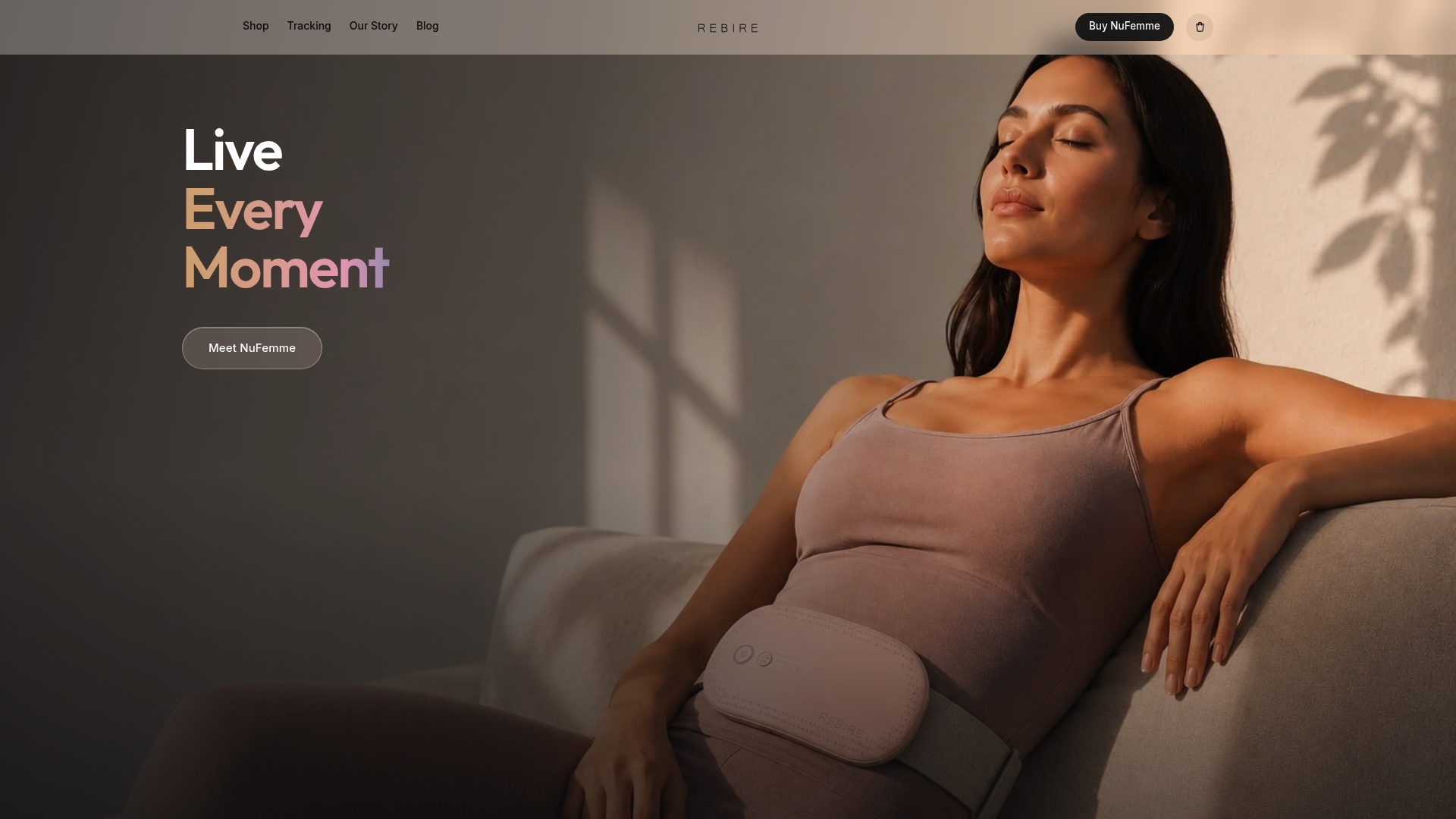
Because it’s rechargeable and discreet enough to wear under your clothes, you get sustained relief through a workday, a commute, or a full night’s sleep prep, without waiting at home for a plug-in pad to heat up. The three settings mean you can start low and adjust as your cramps demand, following the exact protocol this guide walks through. It also comes finished in Rose Gold or Ivory, which makes it a thoughtful gift from someone who’s noticed what you go through every month rather than a last-minute pharmacy grab.
Ready to feel the difference for yourself? Shop NuFemme and find your comfortable heat setting today.
This article is general information, not a substitute for advice from a qualified doctor. Consult a qualified healthcare professional about your own circumstances before acting on anything here.
Sources
- Heat therapy for primary dysmenorrhea: a systematic review and meta-analysis - PMC
- Superficial heat therapy in women’s health - Frontiers in Medicine (2026)
- Systematic reviews and RCT evidence on heat therapy (Nature/s41598 review, 2018)
- How to use a heating pad to heal and ease pain from muscle injuries - Cedars-Sinai