

The loose fetal position, curled on your side with a pillow between your knees, is the most reliable way to sleep with period cramps because it relaxes your abdominal muscles instead of fighting them. Pair it with a heating pad on your lower belly or lower back for 20 to 30 minutes before you lie down. If pain is severe, unusual, or doesn’t match your normal pattern, that’s a reason to call your doctor, not push through it.
TL;DR:
- Keeping your fetal curl loose with a pillow between your knees significantly reduces abdominal tension and enhances cramp relief during sleep.
- Applying heat therapy before bed, such as a heat pad or hot water bottle, improves blood flow and relaxes uterine muscles more effectively when timed correctly.
- Using gentle stretching or light movement before sleep can loosen muscles and pelvis tension, making your preferred sleep position more comfortable.
- Supporting your hips with proper pillow placement prevents back strain, especially for side or back sleepers, and aids in better spinal alignment.
- Combining supportive sleep positions with a calming wind-down routine and leak-proof protection minimizes discomfort and interruptions caused by cramps and bleeding overnight.
Table of Contents
- How to Find the Best Sleep Position for Period Cramps
- What Else Helps You Sleep Through Cramps?
- Setting Up Your Bed for Fewer Overnight Wake-Ups
- How Do You Manage Leaks While Sleeping With Cramps?
- Building a Wind-Down Routine That Actually Reduces Pain
- When Should You See a Doctor About Period Cramps?
- A Perspective on What Actually Helps You Sleep During Your Period
- A Hands-Free Way to Bring Heat and Massage to Bed
- Sources
- FAQ
How to Find the Best Sleep Position for Period Cramps
Cramps at night are worse than cramps during the day for a real physiological reason: prostaglandins, the hormone-like compounds that trigger uterine contractions, peak in the first day or two of your period, and lying still gives your brain nothing to distract it from the pain. Your body position either fights that contraction or works with it. Here’s how to set up the five positions that actually help, ranked by how often they work.
Loose fetal curl (side sleeping). Lie on your side and pull your knees up toward your chest, but keep the curl gentle rather than tight. Place a pillow between your knees to keep your hips stacked and your pelvis level. This position relaxes abdominal muscles and reduces pressure on the uterus, which is why it’s the first one to try. Curling too tightly can backfire: pulling your knees hard against your chest increases abdominal tension instead of releasing it, so aim for relaxed, not clenched.
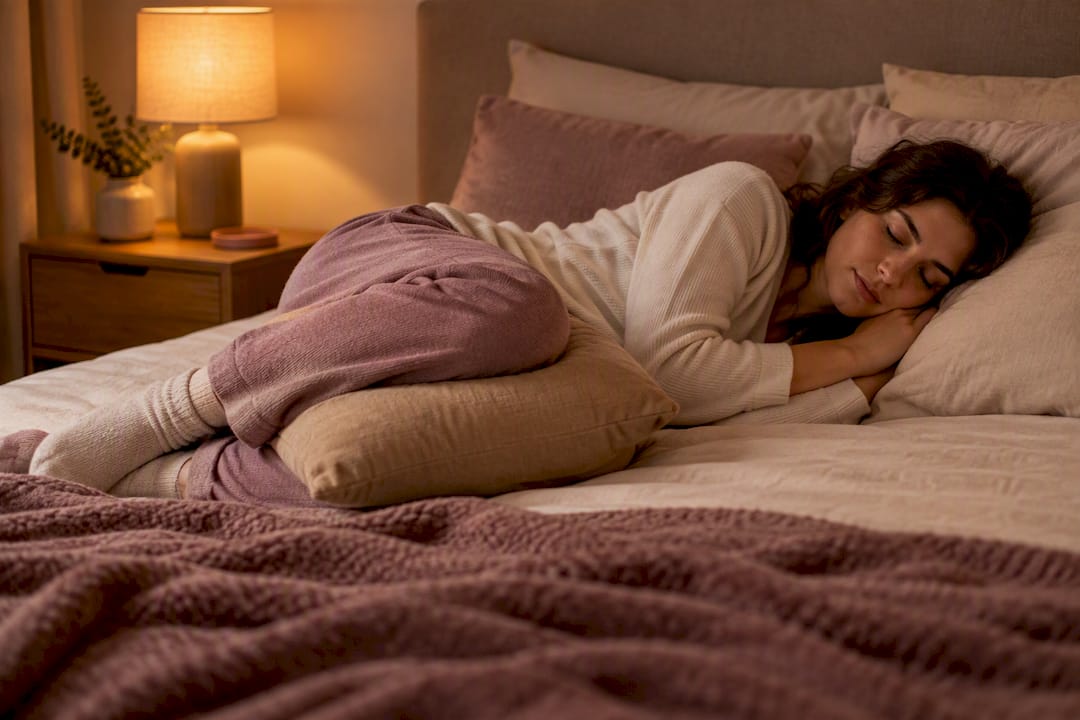
Supported back sleeping. If you sleep on your back, place a pillow under your knees so they bend slightly. This takes pressure off your lower back and keeps your pelvis in a neutral position instead of tilting forward, which can pull on already-irritated uterine muscles. It’s a strong second choice, especially on nights when curling on your side aggravates hip pain.
Semi-fetal (partial curl). A middle ground between flat-back and full fetal, this works well if you toss and turn. Keep one knee bent, one leg extended, with a pillow supporting the bent knee. It gives you the abdominal relief of the fetal position without locking you into one spot all night.
Child’s-pose adaptation. Before bed, not for sleeping through the night, kneel and fold forward over a pillow with your arms extended or tucked at your sides. This gentle stretch decompresses the lower back and can ease cramping enough to make the transition into a fetal sleep position more comfortable.
Modified stomach sleeping. If you’re a committed stomach sleeper, don’t force yourself into a new position cold turkey. Instead, slide a thin pillow or folded towel under your hips. This lifts your pelvis slightly and reduces direct compression on the uterus, which is what makes stomach sleeping painful during your period in the first place.
- Start with the loose fetal curl and a knee pillow before trying anything else.
- If your hips ache in the morning, check that your top knee isn’t dropping forward. Stack it directly over the bottom knee.
- Support your neck with a pillow thick enough to keep your spine level. A flat pillow while side sleeping tilts your neck down and adds tension that radiates into your shoulders.
- Switch positions if one leg or hip goes numb. That’s a circulation cue, not something to sleep through.
Pro Tip: Keep the fetal curl loose, not tight. Squeezing your knees to your chest feels protective, but it tightens abdominal muscles that are already working overtime. A relaxed curl with a pillow between your knees does more for pain relief than a tense one.
What Else Helps You Sleep Through Cramps?
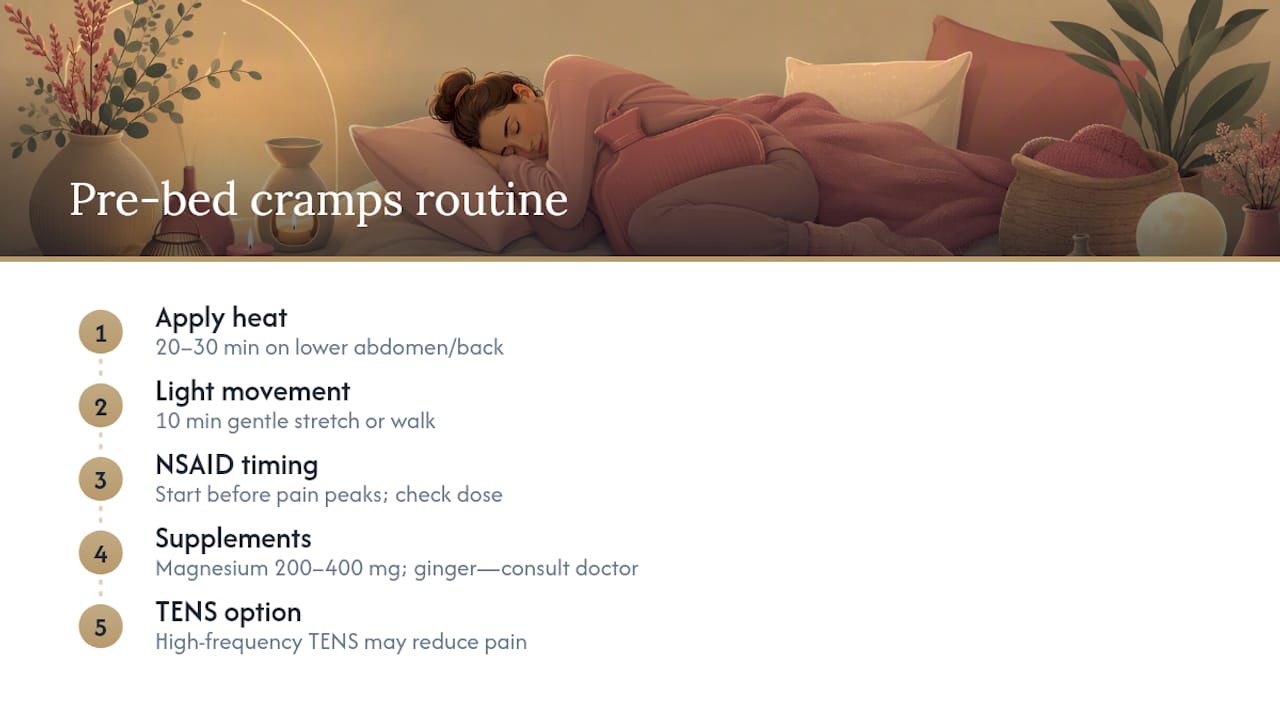
Position solves half the problem. The other half is what you do in the 30 minutes before you lie down. Systematic reviews of self-care approaches for dysmenorrhea point to three consistent winners: topical heat, light exercise, and correctly timed NSAIDs. Here’s how to use each one at night specifically.
Heat, timed right. Apply a heating pad, hot water bottle, or heat patch to your lower abdomen or lower back for 20 to 30 minutes before bed. Heat relaxes uterine muscle and improves local blood flow, and using it before symptoms peak works better than waiting until you’re already in pain. If you use a plug-in heating pad overnight, choose one with an auto shut-off rather than leaving it on all night unattended.
Light movement before bed. Ten minutes of gentle stretching, a short walk, or a few cat-cow poses can loosen the lower back and pelvis enough to make any sleep position more comfortable. Save intense exercise for daytime; you want your body winding down, not revving up, right before sleep.
Supplements, with a caveat. Magnesium, often recommended in the 200 to 400 milligram range, is commonly used for muscle relaxation, and ginger has consistent supportive evidence in reviews of nonpharmacologic options. Evidence quality varies study to study, so talk to a doctor before starting either one regularly, especially if you take other medications.
TENS devices. High-frequency TENS units show mostly positive results in reviews for menstrual pain and offer a drug-free option worth trying if heat alone isn’t enough.
NSAID timing. For those who can safely take them, ibuprofen dosed up to 600 milligrams every six hours works best when started before pain peaks, not after. Talk to your doctor about the right dose and timing for you, particularly if you have any conditions that make NSAIDs risky.
Setting Up Your Bed for Fewer Overnight Wake-Ups
Your pillow arrangement matters as much as your position. A pillow between your knees while side sleeping keeps your hips level and prevents the pelvic rotation that causes lower-back strain by morning. Back sleepers need one under the knees for the same reason. Stomach sleepers do best with a thin pillow or folded towel under the hips to reduce uterine compression.
- A firm-to-medium mattress supports proper hip alignment better than an overly soft one that lets your pelvis sink and twist.
- If your bed has adjustable elevation, raising the head or knees slightly can ease pressure for back sleepers. Adjustable bases designed for back pain work on the same principle: reducing strain through better spinal support.
- A body pillow gives side sleepers full-length support from shoulder to knee, which helps if you tend to shift positions overnight.
- Any powered heat device you use in bed should have a low overnight setting and an automatic shut-off. Skip anything without one.
How Do You Manage Leaks While Sleeping With Cramps?
Worrying about leaks keeps you shifting positions all night, which undoes everything you just set up. Solve that first.
- Menstrual cups or discs can offer up to 12 hours of protection, making them a solid option if you don’t want to think about your period until morning.
- Overnight pads are the simplest option and work well paired with a fitted sheet protector for peace of mind.
- High-absorbency period underwear reduces midnight checks and works well layered under any sleep position, including the fetal curl.
- On heavy nights, double up: a cup or overnight pad plus period underwear gives you a wider safety margin so you can stay in whatever position is easing your cramps.
Building a Wind-Down Routine That Actually Reduces Pain
Stress amplifies pain. When your nervous system is in a heightened state, your brain turns up the volume on pain signals it would otherwise tune down, which is part of why cramps feel worse when you’re anxious about sleeping through them. A short, consistent wind-down routine activates your parasympathetic nervous system, the “rest and digest” side of your body that counteracts that amplification.
Give yourself 30 to 60 minutes before bed for this. A warm shower loosens muscles and mimics the effect of heat therapy. Follow it with a few gentle hip and lower-back stretches, then five minutes of slow breathing, in for four counts, out for six. Keep your bedroom cool, since a warm room makes cramping feel more intense, and cut off caffeine at least six hours before bed since it can worsen both pain sensitivity and sleep quality.
- Dim the lights an hour before bed to support your body’s natural wind-down signals.
- Keep background noise low or use a fan or white noise machine to mask disruptions.
- Skip screens for the last 20 to 30 minutes if you can. It’s less about the light and more about staying mentally calm instead of scrolling into a stressed state right before trying to sleep.
Pro Tip: If your mind races the moment you lie down, try counting your breaths instead of your problems. Slow, deliberate breathing gives your nervous system a clear signal to downshift, which matters more on period nights than any other.
When Should You See a Doctor About Period Cramps?
Most period pain is normal, but a few signs mean it’s time to get checked out: pain severe enough to stop you from working or sleeping despite trying the strategies above, bleeding heavy enough to soak a pad or tampon every hour, or pain that lasts well outside your usual window. These can point to underlying conditions like endometriosis or fibroids that need a clinician’s evaluation, not more home remedies.
Bring a symptom diary tracking when pain starts and peaks, a list of what you’ve already tried, and any medications or supplements you’re taking. That gives your doctor a real pattern to work with instead of a vague description.
A Perspective on What Actually Helps You Sleep During Your Period
Most advice about period pain treats sleep as an afterthought, something that happens once the “real” treatment (medication, heat, rest) has done its job. That gets it backward. Position and pillow setup aren’t a minor add-on to pain management; they’re often the difference between lying awake fighting your body and actually drifting off. A heating pad on the counter doesn’t help you at 2 a.m. if you’ve already shifted positions six times trying to get comfortable.
What’s underrated is how much a “loose” fetal curl matters versus a tight one. People instinctively curl up tightly when they’re in pain, treating it like a protective reflex, when a relaxed curl with proper knee support does more for the actual muscle tension causing the cramp. The fix isn’t complicated, but it’s counterintuitive enough that almost nobody mentions it.
For deeper reading on non-drug approaches, Rebire’s guide to relieving period cramps without medication and its breakdown of drug-free pain relief options both go further into the specific stretches and timing windows touched on here.
— Lavinia
A Hands-Free Way to Bring Heat and Massage to Bed
Heating pads work, but they’re cords, timers, and cooling patches you have to reheat at 3 a.m. NuFemme is a cordless wearable belt that combines heat, vibration massage, and red-light therapy in one device, so you can settle into a fetal curl or supported back position without holding anything in place or getting up to reheat a pad.
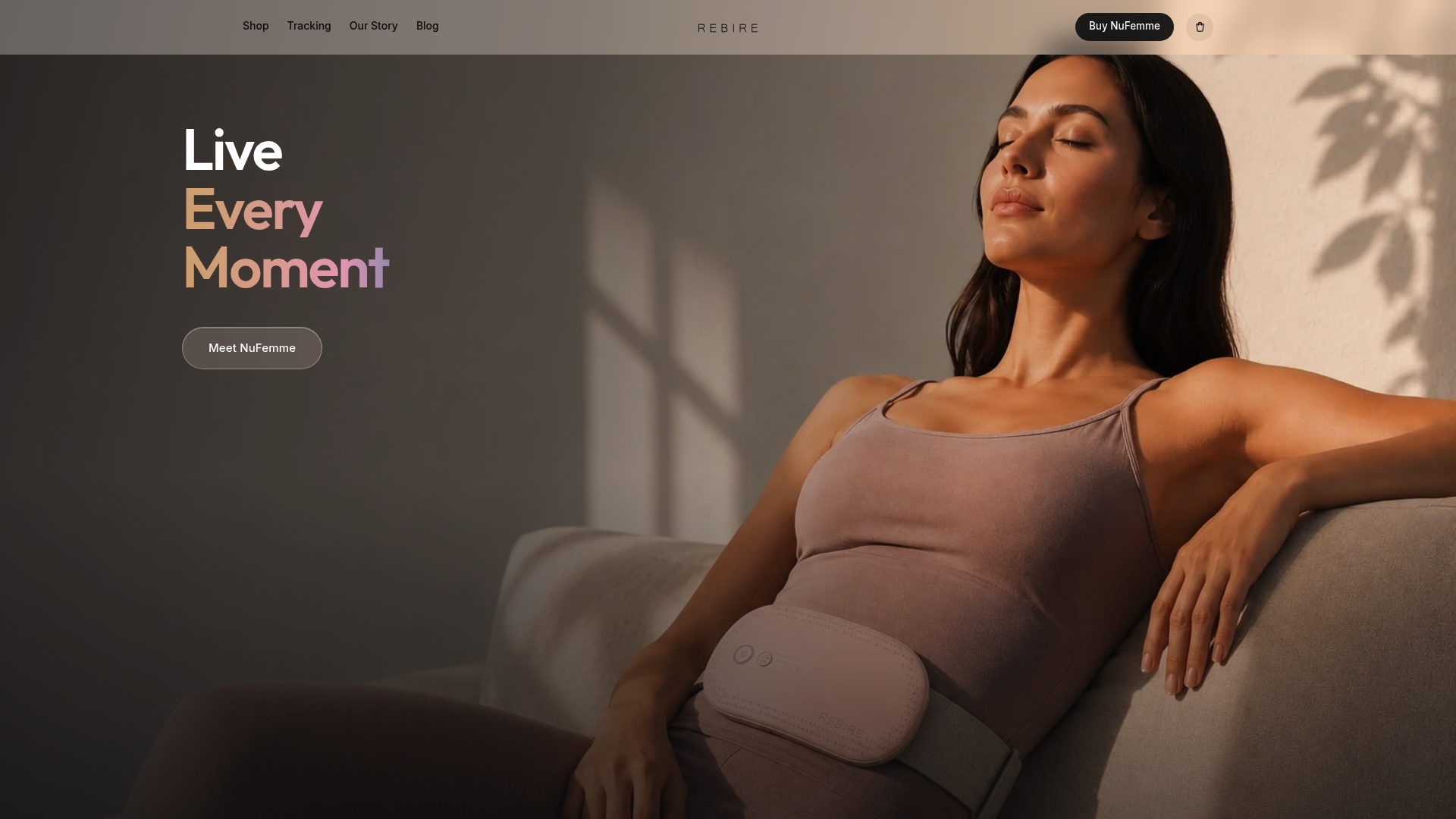
It’s built for anyone who wants relief without managing a cord or a microwaveable pack in the dark, and it’s also a genuinely thoughtful gift for a partner who’s watched you deal with this every month. NuFemme is available in Rose Gold or Ivory and is sold as a one-time purchase on the NuFemme product page. If your cramps are severe or unusual, talk to a doctor before relying on any device, wearable or otherwise, as your main line of relief.
Sources
This guide draws on a systematic review of self-care interventions for dysmenorrhea, Mayo Clinic’s guidance on menstrual cramp treatment, Medical News Today’s review of sleep positions for cramps, and a PubMed Central review of nonpharmacologic pain interventions.
This article is general information, not a substitute for advice from a qualified doctor. Consult a qualified healthcare professional about your own circumstances before acting on anything here.
- Self‐Care for Management of Dysmenorrhea: A Review of Reviews - Wiley Online Library
- Sleeping positions for menstrual cramps - Medical News Today
- Menstrual cramps (dysmenorrhea) - Diagnosis and treatment | Mayo Clinic
FAQ
Does Sleeping Help Period Cramps Go Away?
Sleep doesn’t eliminate cramps, but good sleep positions and quality rest reduce how intense they feel by lowering stress-driven pain amplification. Combining the loose fetal position with heat and a wind-down routine gives you the best shot at actual rest instead of just lying there.
What’s the Worst Day for Period Pain?
For most people, the first one to two days of bleeding bring the worst pain, since that’s when prostaglandin levels peak and trigger the strongest uterine contractions. Pain typically eases noticeably after day two or three.
Why Are Period Pains Worse at Night?
Prostaglandins peak early in your period, and lying still at night removes the daytime distractions that normally dull pain perception. Hormonal shifts around menstruation also fragment sleep, which creates a cycle where pain disrupts sleep and poor sleep makes pain feel worse.
Is It Good to Lay in Bed on Your Period?
Resting is fine and often helpful, but staying in one flat position for hours can increase pressure and stiffness. A supported position, like the loose fetal curl with a knee pillow, gives you rest without the added strain of lying flat and still.
Can a Wearable Device Really Replace a Heating Pad at Night?
For many people, yes. A cordless option delivers heat and massage without the cord, reheating, or careful positioning a traditional heating pad requires, making it easier to stay in a comfortable sleep position all night.