

For strong, fast relief while you’re stationary, a heating pad wins. For discreet, all-day comfort while you’re at your desk or out running errands, an adhesive heat patch wins. Either way, check your skin sensitivity first and never fall asleep with an unattended heat source running.
TL;DR:
- Heating pads provide faster, more intense heat for quick relief, but their use should be limited to 15 to 30 minutes and safety precautions must be followed.
- Adhesive heat patches offer longer, gentler warmth suitable for all-day wear, especially during commuting or errands, with a lower risk of burns if safely applied.
- Both heat sources are effective for superficial relief of menstrual cramps but cannot target deep muscle or organ-level pain.
- Individuals with nerve damage, circulation issues, or skin problems should consult a healthcare professional before using heat therapy devices.
- Cordless wearable devices combining heat, massage, and light therapy can adapt to different daily needs, making them a versatile alternative to separate pads and patches.
Table of Contents
- Heating Pad vs Patches: Comparing Intensity, Duration, and Cost
- How Does Heat Actually Ease Cramps?
- Heating Pad Safety: Who Should Avoid It and What to Watch For
- When Should You Use a Pad vs a Patch?
- How Do You Choose Between a Pad, Patch, or Wearable?
- A Period Pain Specialist’s Take on Pads, Patches, and Wearables
- A Cordless Option That Covers Both Ends of Your Day
- Sources
Heating Pad vs Patches: Comparing Intensity, Duration, and Cost
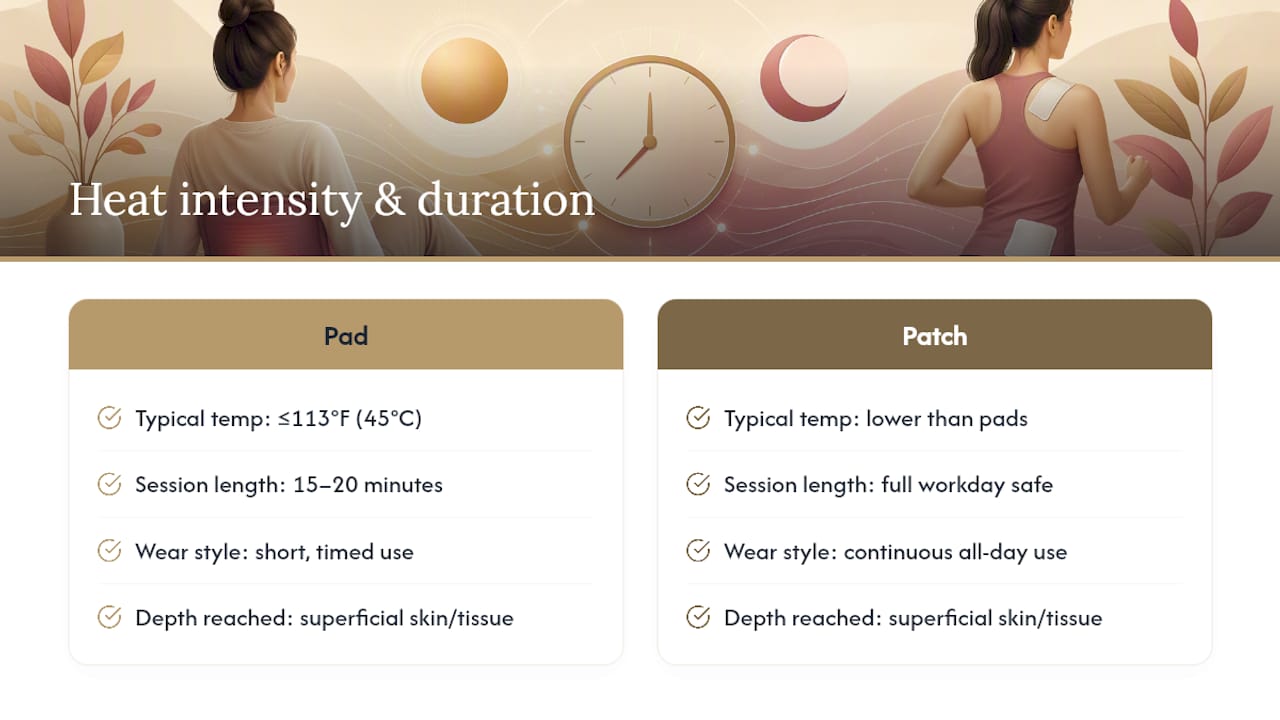
The real difference between these two come down to how fast the heat arrives and how long it sticks around. An electric or microwavable heating pad heats up quickly and hits a higher intensity, which is exactly why it feels so good after a rough day. A heat patch works through a slower, air-activated chemical reaction, so the warmth builds gradually and stays gentle for hours.
Here’s how the two stack up on the details that actually affect your day:
- Heat intensity: Pads deliver faster, stronger heat; patches deliver lower, steadier warmth.
- Duration: Pads are built for 15 to 30 minute sessions; patches often run 6 to 12+ hours on a single application.
- Portability: Patches and rechargeable wearables move with you; pads mostly stay put at home.
- Cost: Pads are reusable and typically run $15 to $40; patches are single-use, at roughly $1 to $3 each time you reach for one.
- Common formats: Electric pads, microwavable rice or gel packs, and rechargeable wearables on one side; disposable adhesive patches on the other.
That cost gap adds up fast. Someone using two patches a week is spending $8 to $24 a month on something a $30 heating pad replaces indefinitely, provided you’re not moving around while wearing it.
How Does Heat Actually Ease Cramps?
Heat works on cramps through a fairly simple mechanism: it widens blood vessels near the skin’s surface, relaxes the tight uterine muscle causing the ache, and raises your local pain threshold so the same cramp signal registers as less intense. That’s not folk wisdom. UCSF’s Pain Management Center confirms that heat therapy can meaningfully ease muscle discomfort, and some trials on menstrual cramps specifically have found continuous low-level heat performing on par with certain over-the-counter pain relievers, though the strength of that evidence varies study to study.
There’s an important limit here worth understanding before you expect miracles from a $2 patch: everything you buy off a shelf delivers superficial heat. It warms skin and the tissue just beneath it. Deep muscle and organ-level relief, the kind a physical therapist might target with ultrasound therapy, isn’t something a heating pad or patch is built to reach. That’s fine for period cramps, since the uterus sits close enough to the abdominal wall to respond well to surface warmth, but it’s worth knowing the ceiling.
On temperature, the sweet spot for comfort and safety sits well below what feels “hot.” Clinical guidance notes that skin contact above 113°F (45°C) starts to feel painful, and most consumer heating pads are designed to stay under that mark on their standard settings. For pads, aim for 15 to 20 minute sessions rather than leaving one on for hours. Patches run cooler by design, generally in a lower temperature range, which is what lets them stay on your skin safely for a full workday.
Heating Pad Safety: Who Should Avoid It and What to Watch For
Heat therapy is low risk for most people, but not everyone should reach for it without a second thought. A few groups need to talk to a doctor before using a heating pad or patch regularly:
- Anyone with diabetes, nerve damage, or neuropathy, since reduced sensation can hide a burn until it’s already serious.
- Anyone with circulation problems, since impaired blood flow changes how the skin responds to sustained heat.
- Anyone with broken, irritated, or recently treated skin at the application site.
- Anyone using heat alongside other treatments like TENS units, since combining an active heat source with electrode adhesive can change how the adhesive behaves and raise burn risk.
Statistic to know: Electric heating pads and blankets are tied to close to 500 fires a year in past safety reporting, most involving older units or damaged cords. That’s a real number worth respecting, not a scare tactic. Check your cord before every use, buy a pad with auto-shutoff, and never use one while sleeping.
Patches carry a different, smaller set of risks, mostly adhesive irritation on sensitive skin. The bigger long-term concern with any heat source, pad or patch, is a condition called erythema ab igne, nicknamed toasted skin syndrome. Repeated exposure to the same patch of skin at low, “comfortable” temperatures can cause lasting mottled discoloration. Catch it early and it clears up; let it go on for months and it can stick around. Rotate where you place your heat, use a thin fabric barrier between skin and device, and don’t run the same spot day after day.
When Should You Use a Pad vs a Patch?
Match the tool to the hours you’re actually living, not the hours you wish you had free.
- Commuting, class, or a full workday: A patch or a slim wearable heat device stays hidden under clothes and keeps working for hours without you thinking about it.
- Evening on the couch: A heating pad or a stronger wearable setting gives you the deeper, more intense relief that’s harder to get from a patch.
- Overnight: Skip active electric heat entirely and let a spent patch (or nothing) carry you through.
- Traveling or running errands: Patches win outright; there’s no cord, no outlet, no waiting.
A safe hybrid routine many people land on: patch in the morning before you leave the house, then a focused 15 to 20 minute pad session in the evening once you’re home and can actually sit still. Never stack heat sources directly on top of each other, and never combine a patch with a heating pad over the same spot at the same time.
Pro Tip: Check the skin under your pad every 10 minutes during a session, and slip a thin cotton layer, like a t-shirt, between the pad and your skin. It barely dulls the warmth but meaningfully cuts burn risk.
How Do You Choose Between a Pad, Patch, or Wearable?
Run through this short checklist before you buy anything:
- How intense are your cramps? Sharp, strong pain usually calls for a pad’s higher heat; mild, background aching often responds fine to a patch.
- Do you need to move? If you’re at a desk or on your feet all day, mobility should decide this for you before cost does.
- Reusable or per-use? A pad pays for itself after a handful of uses; patches are convenient but add up over a cycle.
- How sensitive is your skin? Adhesive-prone skin may do better with a fabric-backed pad than a sticky patch.
- Does the device have real safety features? Auto-shutoff, temperature control, and inspection-friendly cords all matter more than price.
Before buying, ask the seller directly: How long does it hold heat? What’s the max temperature? Is it safe to wear under clothing? What’s the return policy? Walk away from any product that’s vague about temperature or skips safety details entirely. That’s a red flag on a device that sits directly on your skin for hours.
A Period Pain Specialist’s Take on Pads, Patches, and Wearables
Most comparisons treat this as a binary choice, and that’s where they fail people. Your Tuesday commute and your Sunday night on the couch are not the same problem, so why would one product solve both well?
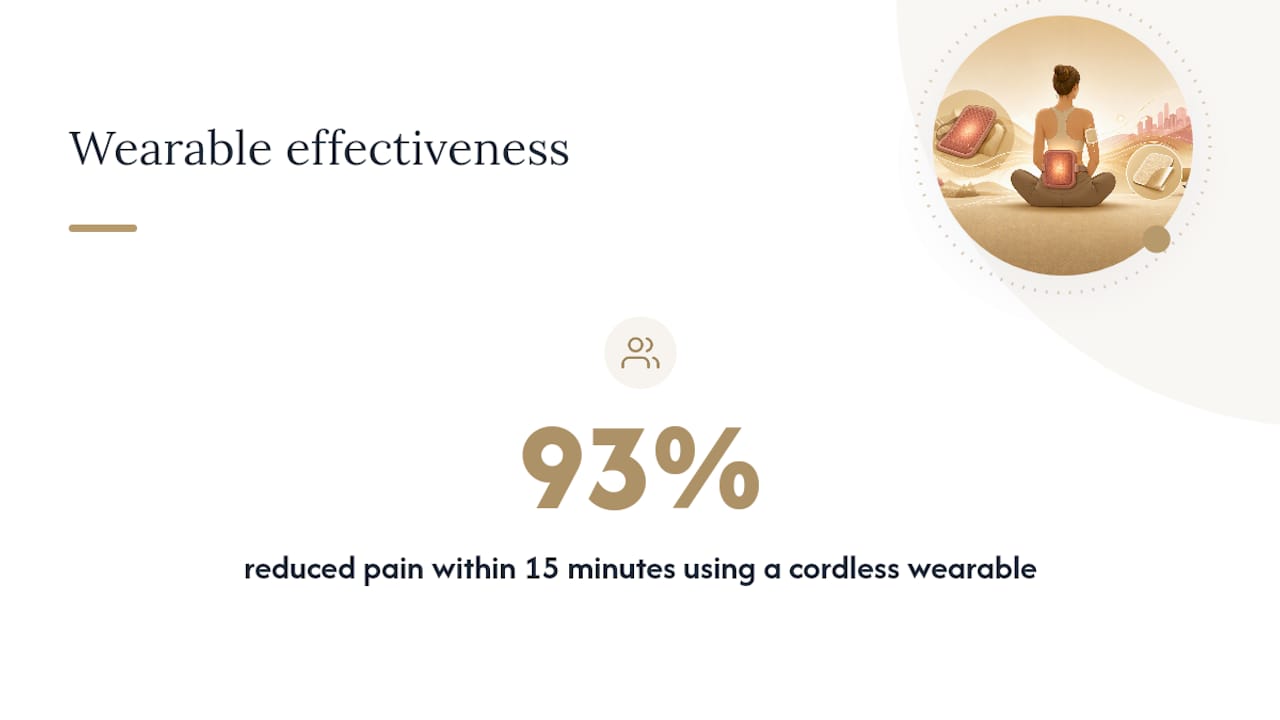
What’s underrated is how much the “right” answer depends on the hour of the day, not just the severity of the cramp. Internal Rebire data found 93% of users reported reduced pain within 15 minutes using a cordless wearable combining heat, massage, and red-light therapy, . That kind of result makes sense once you consider that a wearable with three heat levels and three massage speeds can flex between a patch’s discretion and a pad’s intensity, depending on the setting you choose.
— Lavinia
A Cordless Option That Covers Both Ends of Your Day
If switching between a patch in the morning and a pad at night sounds like more juggling than your cramps deserve, one wearable can cover both jobs. There are cordless wearable devices combining heat, vibration massage, and red-light therapy, with multiple heat levels and massage speeds so users can adjust intensity for different times of day.
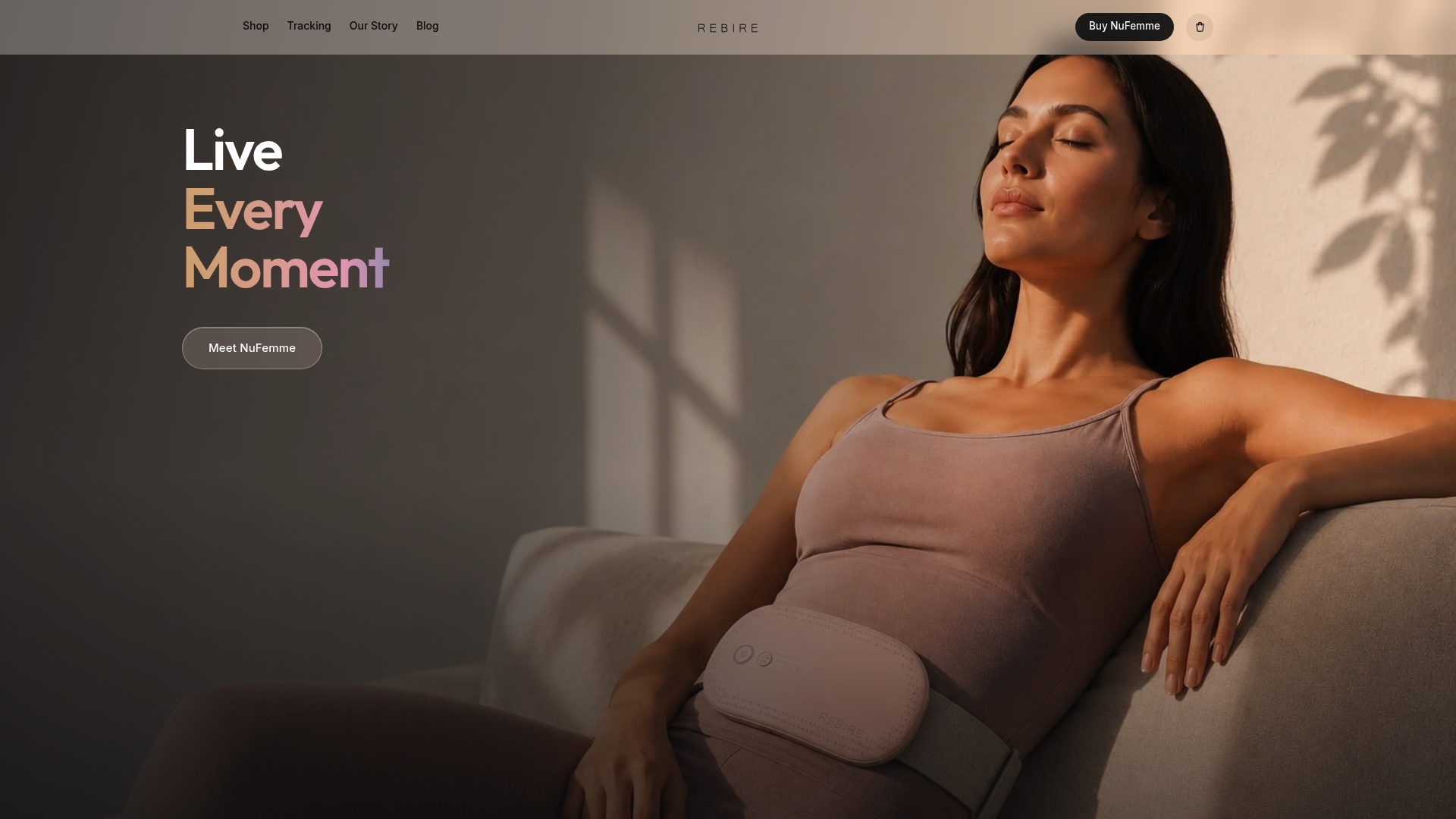
It’s discreet enough to wear under clothing like a patch, and strong enough on its higher settings to rival a stationary pad, which makes it a reasonable fit whether you’re buying it for yourself or picking it out as a thoughtful gift for someone whose monthly pain you’ve actually noticed. Finished in Rose Gold or Ivory, it reads more like a considered gift than a drugstore grab. If you’re weighing a heating pad alternative that doesn’t force you to choose between mobility and strength, check current availability on Rebire’s product page and see which heat and massage combination fits your cycle best.
Sources
- Cold versus heat for pain relief: How to use them safely and effectively - Harvard Health
- Thermal modalities and safety guidance (PMC)
- Treating pain: Heat and cold - UCSF Pain Center
- Heating pads and electric blankets safety - ESFI
- What Is Toasted Skin Syndrome? Heating pad risks to know - Oprah Daily
This article is general information, not a substitute for advice from a qualified doctor. Consult a qualified healthcare professional about your own circumstances before acting on anything here.