

Gentle, restorative yoga and slow breathing can ease many people’s period cramps, sometimes within minutes, and research suggests it can reduce pain further when you practice it regularly over several weeks. It works best as one part of your self-care routine rather than a guaranteed instant fix. Pairing a short yoga sequence with heat tends to bring faster, more noticeable relief than either one alone.
TL;DR:
- A 2024 review found yoga lowered pain by 2.75 points on a 10 centimeter scale after eight weeks of regular practice.
- The eight minute low energy routine uses knees to chest, reclined bound angle, and legs up the wall, avoiding hands and knees poses.
- Breathe in for four counts and out for six, and use pillows or folded towels for support on a bed, couch, or mat.
- Stop any pose that causes sharp or worsening pain; seek care for severe cramps, unusual bleeding, fainting, fever, or pain during sex or bathroom use.
Table of Contents
- How gentle movement and breath actually reduce cramping
- When to scale back and when to see a doctor
- Eight gentle poses that ease cramps and low back ache
- A 15-minute restorative sequence for when cramps start
- Breathing techniques and simple prop swaps
- What the research says about timing and realistic expectations
- A 5-minute routine for your lowest-energy days
- An editorial note on gentle, evidence-based relief
- NuFemme as a portable companion to your yoga practice
- FAQ
- Sources
How gentle movement and breath actually reduce cramping
Period cramps happen because your uterus releases chemicals called prostaglandins, which trigger the muscle contractions that help shed the uterine lining. Higher prostaglandin levels tend to mean stronger cramps. When those muscles contract hard, the surrounding area can tense up in response, and that guarding often makes the pain feel sharper and more constant.
Gentle movement interrupts that cycle. Slow stretches and supported poses increase blood flow to the pelvis and relax the muscles that tighten around the uterus, which can soften the intensity of the cramping itself. Restorative positions also take pressure off your lower back and hips, two areas that often ache right alongside your abdomen during your period.
Breath plays an equally large role. A longer exhale activates your parasympathetic nervous system, the part of your body responsible for calming things down after stress or pain. When you breathe slowly and fully, your muscles get a signal to release rather than brace, which is part of why a few minutes of supported child’s pose with deep breathing can feel more effective than it sounds.
This isn’t just a feeling. A 2024 network meta-analysis of exercise interventions for primary dysmenorrhea found that regular practice, including yoga, reduced pain after eight weeks compared with no intervention.
Why gentle yoga tends to help:
- Slow stretching increases blood flow to the pelvis and eases muscle tension around the uterus.
- Longer exhales calm your nervous system, which can reduce the sense of bracing against pain.
- Supported positions take weight off your lower back and hips, common secondary pain sites.
- Regular practice appears to build cumulative benefit rather than only offering in-the-moment relief.
Yoga’s measured effect: The 2024 network meta-analysis found yoga reduced pain by a mean difference of −2.75 on a 10-cm pain scale after eight weeks of practice. That’s a meaningful drop, though it reflects consistent practice over time, not a single session.
When to scale back and when to see a doctor
Yoga for cramps should never hurt more than your cramps already do. If a pose creates sharp, radiating, or worsening pain, stop and come out of it slowly. Gentle is the entire point here: you’re looking for ease, not a workout.
Most period pain responds to rest, heat, and gentle movement. But some symptoms point to something that needs a clinician’s attention rather than a yoga mat.
Signs you should check in with a doctor:
- Pain that is severe, sudden, or steadily getting worse cycle after cycle.
- Bleeding that’s unusually heavy, prolonged, or irregular compared with your normal pattern.
- Fainting, dizziness, or feeling like you might pass out.
- Fever alongside pelvic pain.
- Pain during sex or when using the bathroom that wasn’t there before.
According to NHS guidance on period problems, persistent or unusual pain patterns are worth discussing with a healthcare provider, since they can sometimes signal conditions like endometriosis or fibroids that need their own treatment plan. Yoga can be a comforting part of your routine either way, but it isn’t a substitute for medical evaluation when something feels off.
Eight gentle poses that ease cramps and low back ache
You don’t need yoga experience or special equipment to get relief from these poses. Each one can be modified with pillows, folded towels, or a couch, and held as briefly or as long as feels good.
-
Supta Baddha Konasana (reclined bound angle). Lie on your back, bring the soles of your feet together, and let your knees fall open to the sides. This gently opens your hips and relieves pressure in your low belly. Place pillows under each knee if your hips feel tight, and breathe slowly for 2 to 5 minutes.
-
Supported child’s pose. Kneel and fold forward over a pillow or folded blanket placed under your torso and forehead. This eases low back tension and gives your belly a gentle, comforting compression. Widen your knees if you want more room for your abdomen, and stay for 1 to 3 minutes.
-
Cat-cow. On hands and knees, alternate between arching your back (cow) and rounding it (cat) in rhythm with your breath. This mobilizes your spine and pelvis, which can loosen the muscles that grip around cramps. Move slowly for 8 to 10 rounds, inhaling into cow and exhaling into cat.
-
Knees-to-chest (Apanasana). Lying on your back, hug both knees toward your chest and rock gently side to side. This is one of the simplest ways to relieve pressure directly in your lower abdomen. Hold for 1 to 3 minutes, adding small circles with your hips if it feels good.
-
Reclined twist (Supta Matsyendrasana). From your back, drop both knees to one side while keeping your shoulders flat on the floor. This releases tension through your low back and obliques without any real exertion. Hold 1 to 2 minutes per side, using a pillow under your knees for support.
-
Legs-up-the-wall (Viparita Karani). Lie on your back with your legs extended up a wall, or rest them on a couch or your bed’s headboard if you don’t have open wall space. This position encourages blood flow away from a congested pelvis and tends to feel deeply calming. Stay for 5 to 10 minutes with your arms relaxed at your sides.
-
Supported forward fold. Sit with your legs extended or crossed and fold forward over a stack of pillows placed on your lap or thighs. This gentle compression can ease cramping while calming your whole body. Rest your forehead on the pillows and stay for 2 to 4 minutes, only folding as far as feels comfortable.
-
Supported savasana. Lie on your back with a pillow under your knees and another under your head, letting your whole body release into the floor or bed. This final resting pose lets your nervous system settle after the other poses. Stay for 3 to 5 minutes, or longer if you have the time.
Household items work just as well as yoga props here. A firm couch cushion or a few folded towels stacked lengthwise can substitute for a bolster, and a sofa arm or headboard can replace a wall for legs-up-the-wall variations.
On heavier flow or low-energy days, shorten every hold and skip anything that asks you to be on your hands and knees for long. Knees-to-chest and supported savasana alone can be enough.

Pro Tip: Add tiny pelvic circles or gentle rocking inside any supported pose. The small, repetitive movement increases blood flow to the area without adding effort.
A 15-minute restorative sequence for when cramps start
This sequence moves through the poses above in an order designed to build relief gradually, starting with gentle mobilization and ending in full rest. Breathe throughout with a 4-count inhale and a 6-count exhale, letting the longer exhale do the calming work.
- Cat-cow for 2 minutes to warm up your spine and pelvis.
- Knees-to-chest for 2 minutes, rocking gently side to side.
- Supta Baddha Konasana for 3 minutes, pillows under both knees.
- Reclined twist, 1.5 minutes per side.
- Supported child’s pose for 2 minutes, pillow under your torso.
- Legs-up-the-wall for 3 minutes.
- Supported savasana for 2 minutes to close.
If you’re short on time or energy, an 8-minute version works too: knees-to-chest (2 minutes), Supta Baddha Konasana (3 minutes), and legs-up-the-wall (3 minutes) cover the most ground with the least effort.
If you want more, extend to 25 minutes by adding a longer hold in legs-up-the-wall (8 to 10 minutes) and finishing with 5 minutes of supported savasana instead of 2.
You can do this sequence on a yoga mat, but it works just as well on your bed. Keep a heating pad on your lower belly during the forward fold and savasana sections for extra relief, and stop any pose immediately if it increases sharp or radiating pain rather than easing it.
Breathing techniques and simple prop swaps
Breath is doing as much work as the poses themselves, so it’s worth practicing on its own, too. Diaphragmatic breathing, where your belly rises and falls instead of your chest, signals your body to relax rather than brace against pain.
A simple pattern to try: inhale through your nose for a count of 4, then exhale slowly for a count of 6. The longer exhale is what triggers the calming response, so don’t rush it.
A 1 to 2 minute micro-practice between poses:
- Place one hand on your belly and one on your chest.
- Inhale for 4 counts, feeling your belly hand rise more than your chest hand.
- Exhale for 6 counts, letting your belly fully soften.
- Repeat for 8 to 10 rounds before moving to your next pose.
If you want to go deeper into breath work, our partner’s guide to breathing improvement techniques walks through additional patterns worth exploring.
You likely already have everything you need for props. A firm couch cushion or several folded bath towels stacked lengthwise work well as a bolster substitute, a flat pillow supports your head in savasana, and a dining chair can prop your calves for a modified legs-up-the-wall if a wall or headboard isn’t available.
Pro Tip: Keep a small stack of pillows and a folded blanket near your bed during your period so your setup takes seconds, not minutes, when cramps hit.
What the research says about timing and realistic expectations
It helps to know what yoga can and can’t promise. No single pose eliminates cramps instantly for everyone, and the clearest evidence points to benefit building over weeks of consistent practice rather than appearing in one session.
The 2024 network meta-analysis found that exercise interventions, including yoga, reduced menstrual pain measurably after eight weeks of regular practice. A separate 2024 systematic review of 29 randomized trials reported that relaxation exercises and other movement types reduced pain within 4 to 8 weeks, with relaxation techniques ranking highest at the eight-week mark while yoga also showed measurable benefit in that same window.
What the guidelines recommend:
- ACOG lists yoga and relaxation techniques among nonpharmacological approaches for dysmenorrhea, alongside heat and other self-care measures.
- NHS guidance recommends gentle exercise, warmth, and relaxation techniques including yoga as frontline self-care for period pain.
- Both sources frame yoga as one piece of a broader self-care approach rather than a standalone cure.
What a regular practice can realistically do: Studies show measurable pain reduction after 8 weeks of consistent exercise or yoga practice, according to the 2024 network meta-analysis. That means the real payoff often comes from practicing through more than one cycle, not expecting a single session to erase the pain.
In the short term, think of yoga as taking the edge off: easing tension, slowing your breath, and giving your body a break from bracing. Over a few cycles of regular practice, it appears to do more than that.
A 5-minute routine for your lowest-energy days
Some days, even a mat feels like too much. On those days, you can do almost everything from bed.
- Lie on your back and hug both knees to your chest, rocking gently side to side for 1 to 2 minutes.
- Let your knees fall open into a reclined butterfly shape, resting a pillow under each knee, and breathe slowly for 2 minutes.
- Prop your calves up on a stacked pillow or against your headboard for a mini legs-up-the-wall, staying for 2 minutes.
- Finish lying flat with a pillow under your knees, breathing with a long exhale for 1 to 2 minutes.
Add a heating pad or take a warm shower before or after this routine for extra comfort, and skip any step that doesn’t feel right that day. This is meant to meet you where you are, not add another task to your list.
An editorial note on gentle, evidence-based relief
I’ve spent a long time looking at what actually helps with period pain versus what just sounds good in a headline, and gentle yoga earns its place because the research backs consistent practice, not miracle poses. At Rebire, we try to pair that same evidence-first approach with practical tools, including the NuFemme wearable for people who want relief they can take with them.
We offer a cordless wearable that eases period cramps using heat, massage, and red-light therapy in one belt, featuring adjustable heat levels and massage speeds so users can find what feels right. It’s also designed as a thoughtful gift, available in stylish finishes, for partners who want to show care and attention.
— Lavinia
NuFemme as a portable companion to your yoga practice
Yoga works beautifully when you have 15 minutes and a quiet space, but cramps don’t wait for convenient moments. That’s where a wearable device fits into the picture: cordless, discreet enough to wear under your clothes, and it combines heat, massage, and red-light therapy in a single belt, so you can get relief at your desk, on a commute, or anywhere a yoga mat isn’t practical.
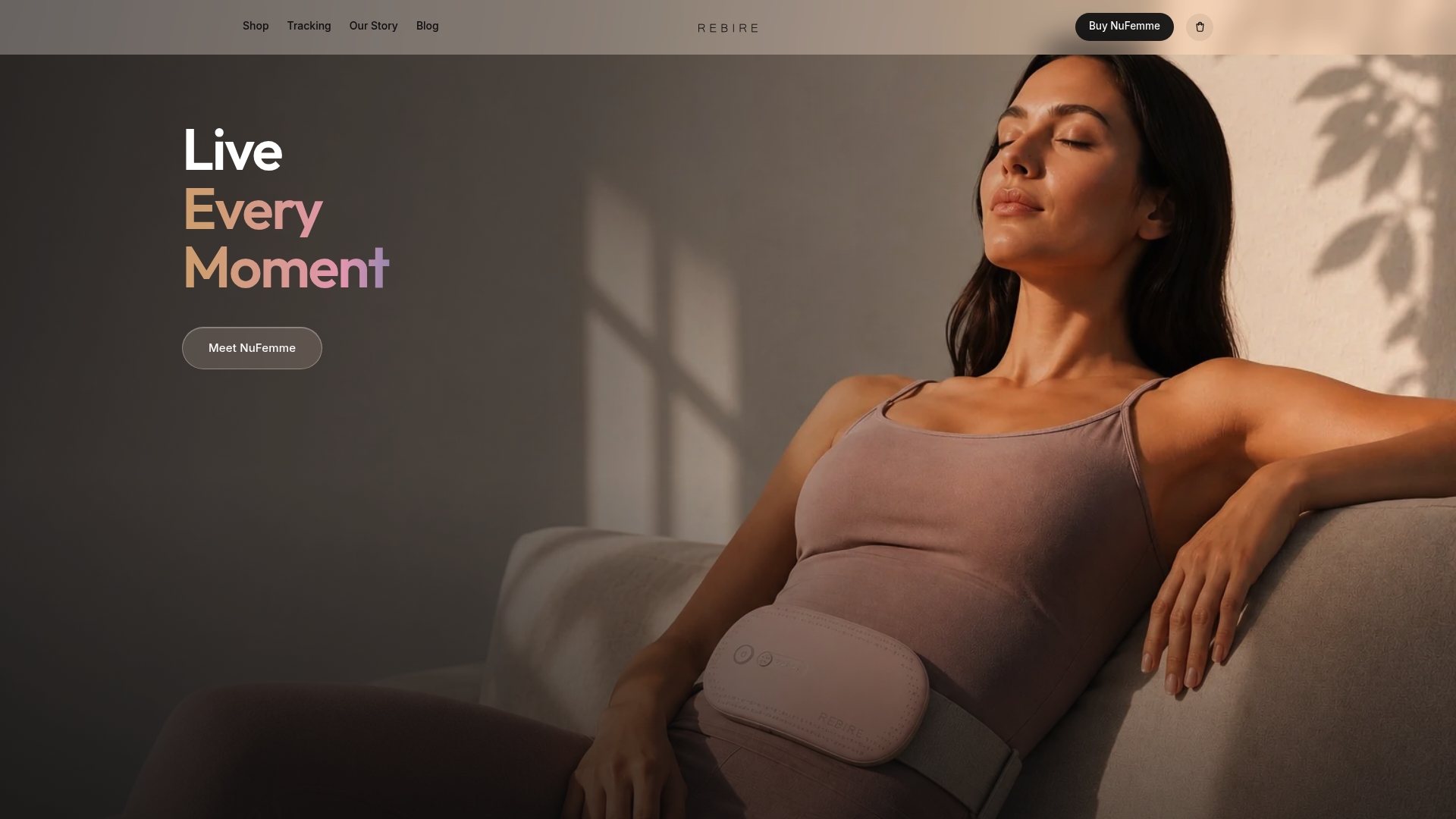
What makes it a natural pairing with a yoga routine:
- Adjustable heat levels and massage speeds let you match intensity to how you feel that day.
- No cord and no waiting at home for a heating pad to warm up.
- Reported user feedback indicates that many experience reduced pain within 15 minutes of use.
- Its discreet design allows you to wear it through a workday before settling into an evening yoga sequence.
It also makes a genuinely considered gift. Finished in Rose Gold or Ivory, NuFemme is the kind of present that tells a partner you’ve noticed what she deals with every month, rather than a last-minute pickup on the way home. You can find the full details and order yours on the NuFemme product page.
This article is general information, not a substitute for advice from a qualified doctor. Consult a qualified healthcare professional about your own circumstances before acting on anything here.
FAQ
What yoga can be done during periods?
Gentle, restorative poses work best during your period, including Supta Baddha Konasana, child’s pose, knees-to-chest, reclined twists, and legs-up-the-wall. These positions ease cramping and low back tension without demanding much energy, and you can scale the intensity based on how you feel that day.
What is the 7-2-1 rule for menstruation?
This isn’t a term supported by major clinical or research sources, so there’s no single agreed-upon definition to point to. If you’ve seen it referenced somewhere specific, it likely reflects one creator’s personal framework rather than established medical guidance.
What stretches can help with lower back pain during periods?
Cat-cow, supported child’s pose, and reclined twists are especially effective for low back pain during your period, since they mobilize your spine and release tension around your pelvis. Holding each for one to three minutes with slow breathing tends to bring the most relief.
What gets rid of period cramps asap?
Heat applied directly to your lower abdomen, paired with gentle movement like knees-to-chest or legs-up-the-wall, tends to bring the fastest relief. A wearable device combining heat and massage, like NuFemme, is a practical option when you need relief quickly.
Sources
- PubMed: Network meta-analysis on exercise interventions for primary dysmenorrhea (2024)
- NHS — Period problems: causes and self-care
- ACOG — Dysmenorrhea: Painful Periods (FAQ)
- Comparative effectiveness of different exercises for reducing pain intensity in primary dysmenorrhea (2024)